
Still undecided whether to learn Hebrew or not? Go ahead, and you’ll be rewarded with eight incandescent nights, a mountain of doughnuts and a language with 3,000 years of history behind it.
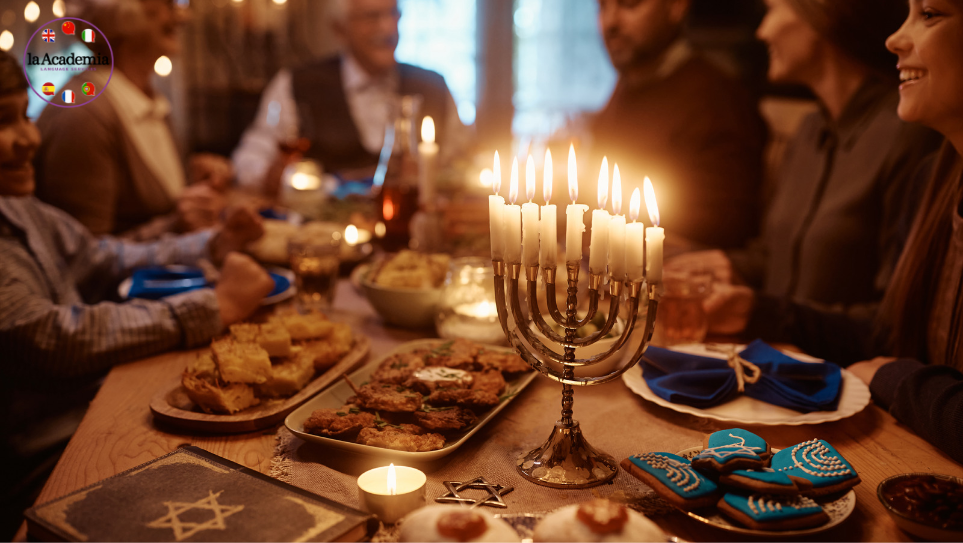
Of course, we’re referencing Hanukkah – the Festival of Lights – from sundown on 4th December to nightfall on 12th December.
And frankly, there’s no better excuse to get cosy with Hebrew.
A Potted History of Hanukkah
According to the Encyclopedia Britannica there’s no evidence of Hanukkah being rooted in Hebrew. It states: “Although not mentioned in the Hebrew Scriptures, Hanukkah came to be widely celebrated and remains one of the most popular Jewish religious observances”.
What we know is it all started back in the 2nd century BC, when King Antiochus IV outlawed Jewish worship and defiled the Second Temple in Jerusalem.
Enter the Maccabees, a scrappy band of rebels led by Judah Maccabee, who battled to win it back.
The headlines we recognise today include:
- The name – Hanukkah means “dedication” in Hebrew, which nods to the restoration and rededication of the temple.
- The miracle – There was only enough oil to light the menorah (multi-branched candelabra) for a single day. But it glowed for eight.
- The party – Another additional candle is lit on the hanukkiah (nine-branched candelabra) every night, using the shamash (helper candle), dreidels (gaming toys) spin for chocolate gelt (coins), and fried treats like latkes (potato pancakes) and sufganiyot (jam doughnuts) are practically compulsory.
But, what about the language?
Is it Worth the Effort to Learn Hebrew in 2027?
Hebrew isn’t the biggest kid on the language block, with around 9 million speakers. But it more than compensates in personality. It’s ideal if any of the following factors light you up:
- Tech and business – Israel’s buzzing tech scene speaks Modern Hebrew (besides IT jargon).
- Travel and culture – Confidently traverse Tel Aviv, binge Israeli TV without subtitles and connect with Jewish communities worldwide.
- History and faith – Read ancient texts with no translation required.
- Qualifications – UK learners can even sit a GCSE in Modern or Biblical Hebrew.
Ignite Your First Words
At la Academia, you’ll discover engaging options to learn Hebrew at your own convenience and pace, letting your newfound language skills shine.
Get in touch to book a Hebrew taster lesson with us and make this your brightest festive season yet.